AI Drug Discovery
AI Drug Discovery is the application of machine learning, deep learning, and generative AI to the process of finding, designing, and developing new pharmaceutical compounds. The traditional drug development pipeline takes 10-15 years and costs over $2 billion per approved drug, with a failure rate exceeding 90%. AI is compressing timelines, reducing costs, and — most importantly — finding molecules that human chemists wouldn't have considered. By 2026, dozens of AI-discovered drug candidates are in clinical trials, and the first AI-designed drugs are approaching regulatory approval.
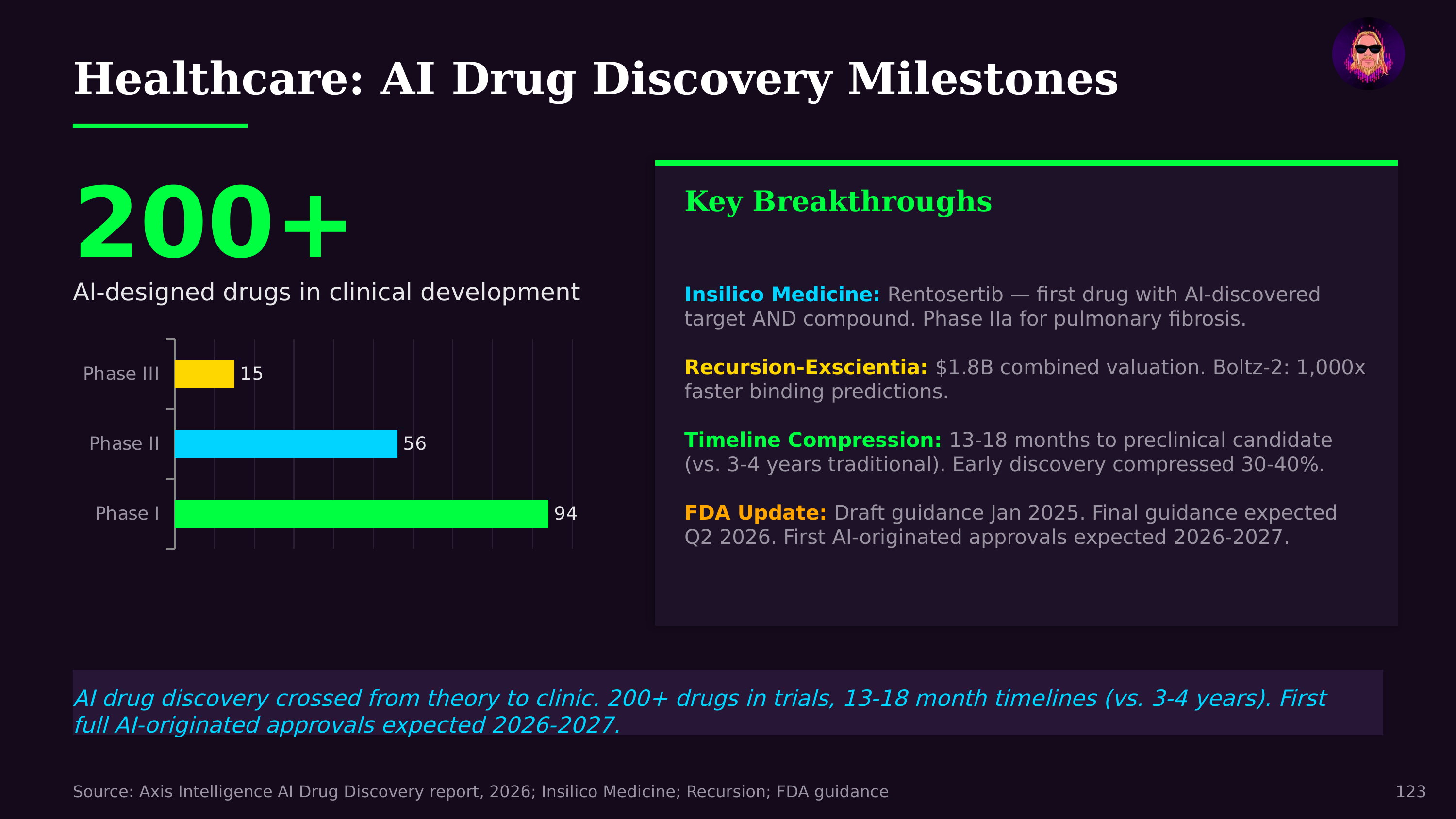
The landscape starts with AlphaFold AI Drug Discovery, DeepMind's protein structure prediction system, which solved one of biology's grand challenges by predicting the 3D structure of virtually every known protein. But AlphaFold was the beginning, not the end. The next generation of AI tools goes beyond prediction to design: generative models that propose novel molecular structures optimized for specific biological targets, predict how those molecules will behave in the body (pharmacokinetics), estimate toxicity before any lab work, and suggest synthesis routes for manufacturing. Companies like Insilico Medicine, Recursion Pharmaceuticals, Isomorphic Labs (DeepMind's drug discovery spinoff), and Xaira Therapeutics are building end-to-end AI-driven drug discovery platforms.
The key technical approaches include: Molecular generation using diffusion models and language models trained on chemical structures (SMILES notation and molecular graphs) to propose novel compounds. Protein-ligand docking prediction to estimate how strongly a candidate molecule will bind to a target protein. Virtual screening of billions of candidate molecules in silico, filtering the vast chemical space down to hundreds of promising leads in days rather than years. Retrosynthetic analysis using AI to plan the chemical reactions needed to manufacture a designed molecule. And clinical trial optimization using patient data to design more efficient trials, predict patient responses, and identify biomarkers for stratification.
The 2025-2026 moment is significant because AI-discovered drugs are now reaching the clinical validation stage that determines whether the technology truly works. Insilico Medicine's anti-fibrosis drug INS018_055 (designed entirely by AI) entered Phase II trials. Recursion is running multiple AI-identified candidates through clinical stages. Absci, Generate Biomedicines, and others are using generative AI to design antibodies and proteins with specific therapeutic properties. The question has shifted from "can AI discover drugs?" to "how much faster and cheaper can AI make the process?" Early data suggests: significantly — with preclinical timelines compressed from years to months.
The convergence with other AI trends is powerful. Foundation models trained on biological data (protein sequences, gene expression, clinical records) are creating "biology GPTs" that can reason about living systems the way language models reason about text. Multimodal AI that combines molecular, genomic, imaging, and clinical data is enabling a more holistic approach to drug design. And the same GPU infrastructure built for language model training is being repurposed for molecular simulation at unprecedented scale.
Further Reading
- AlphaFold AI Drug Discovery — The breakthrough that catalyzed AI drug discovery
- AI for Science — The broader scientific AI revolution
- AI in Healthcare — The clinical context