AI in Healthcare
AI in healthcare encompasses the application of machine learning, natural language processing, computer vision, and large language models to medical diagnosis, drug discovery, clinical decision support, and healthcare operations. Healthcare represents one of the highest-impact and most complex domains for AI deployment, where the technology's potential to save lives must be balanced against the consequences of errors.
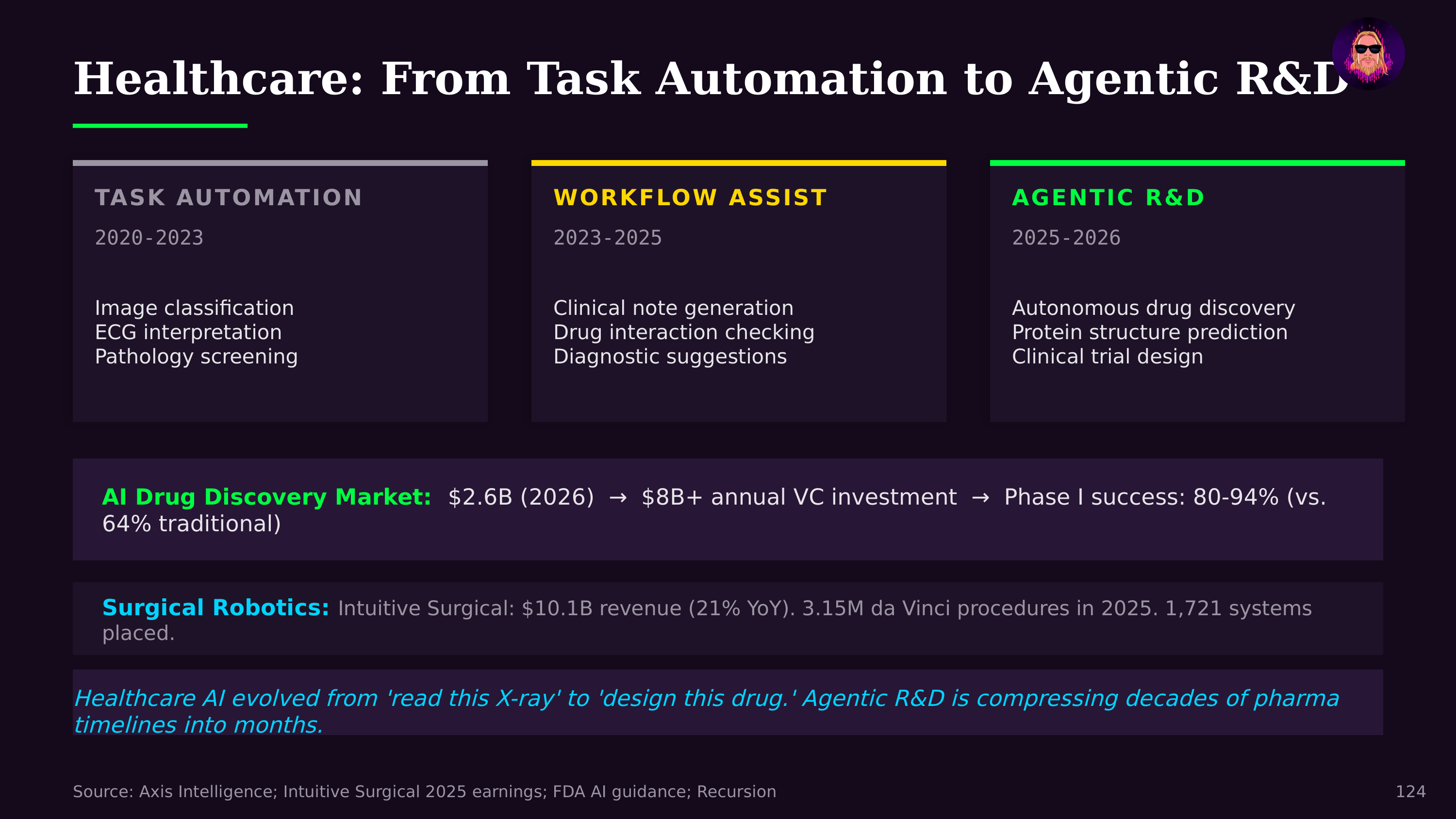
Medical imaging is the most mature clinical AI application. Deep learning models analyze X-rays, CT scans, MRIs, and pathology slides to detect diseases with accuracy matching or exceeding specialist radiologists for specific conditions. FDA-cleared AI tools screen for diabetic retinopathy, detect breast cancer in mammograms, identify pulmonary nodules in chest CTs, and flag stroke-indicating brain hemorrhages for urgent review. The key insight: AI doesn't replace radiologists but prioritizes their workload, flagging critical findings in seconds rather than hours.
Drug discovery has been revolutionized by AI, particularly through protein structure prediction. AlphaFold AI Drug Discovery's ability to predict protein folding has accelerated understanding of drug targets. AI models now screen billions of potential molecular compounds in silico (computationally), identifying candidates that would take years to discover through traditional wet-lab methods. The drug development pipeline — from target identification to clinical trials — is being compressed at every stage by AI-driven scientific discovery.
Clinical decision support uses AI to assist physicians with diagnosis, treatment planning, and risk assessment. LLMs are being integrated into clinical workflows for medical record summarization, differential diagnosis generation, and patient communication. Studies show LLMs performing at or above physician levels on medical licensing exams, though clinical deployment requires careful validation, as AI hallucinations in medical contexts can be dangerous.
Genomics and personalized medicine use AI to analyze genetic data and tailor treatments to individual patients. Machine learning models identify genetic risk factors, predict drug responses based on patient genotype, and guide precision oncology (matching cancer treatments to the specific mutations driving a patient's tumor). The combination of declining sequencing costs and improving AI analysis is making personalized medicine practical at scale.
Operational efficiency applies AI to healthcare's administrative burden. Prior authorization automation, clinical documentation (AI-generated notes from patient encounters), scheduling optimization, and supply chain management can reduce the estimated 25-30% of healthcare spending consumed by administrative overhead. This operational layer may deliver faster ROI than clinical AI, though it lacks the same transformative potential.
The challenges are significant: data privacy (medical records are among the most sensitive personal data), regulatory requirements (FDA approval, clinical validation), liability questions (who is responsible when AI assists a wrong diagnosis), bias in training data (models trained predominantly on certain demographics may perform poorly on others), and integration with legacy hospital IT systems. Despite these hurdles, AI in healthcare is advancing rapidly, driven by the scale of the opportunity and the urgency of improving health outcomes.
Further Reading
- The State of AI Agents in 2026 — Jon Radoff