Snow Crash
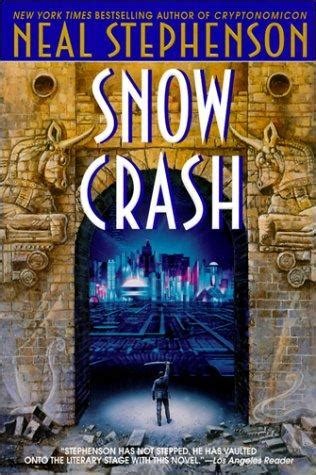
Snow Crash is Neal Stephenson's 1992 novel that gave the world two words now embedded in the vocabulary of technology: Metaverse and avatar. The book imagines a near-future America where the federal government has largely dissolved into franchise-operated sovereign enclaves — Mr. Lee's Greater Hong Kong, Nova Sicilia, Narcolombia — while a shared, persistent virtual world called the Metaverse serves as the dominant social and economic space. The protagonist, Hiro Protagonist (yes, really), is a freelance hacker and pizza delivery driver for the Mafia who discovers a new drug called Snow Crash that can infect people both in the Metaverse and in physical reality.
The Metaverse as Stephenson describes it is not a game or a website — it is a place. Users access it through personal terminals and appear as avatars of varying quality, depending on their technical skill and economic means. The Metaverse has geography: a single road called the Street that stretches 65,536 kilometers around the equator of a black sphere. Real estate on the Street is bought, developed, and speculated upon. Social hierarchies emerge: off-the-shelf avatars mark you as a tourist; custom-coded avatars signal status. This vision — of a persistent, shared 3D space with its own economy, social norms, and spatial logic — is the direct ancestor of every serious metaverse project that followed, from Second Life to the wave of platform announcements that followed Meta's 2021 rebrand.
The linguistic virus at the novel's core is one of Stephenson's most ambitious ideas. Snow Crash is simultaneously a drug, a virus, and a piece of Sumerian nam-shub — a speech act that programs the brain directly through the deep structures of language. Stephenson draws on the hypothesis that ancient Sumerian was a programming language for the human nervous system, and that the Tower of Babel event was essentially a patch that broke the exploit by diversifying human languages. In the novel, a media mogul named L. Bob Rife has rediscovered this exploit and weaponized it. The metaphor is sharp: information can be a virus, language can be malware, and the boundary between code and cognition is thinner than we imagine. In an era of deepfakes, algorithmic manipulation, and AI-generated content, this idea feels less speculative and more diagnostic.
The political economy of Snow Crash anticipates several real-world trends. The franchised nation-states resemble the platform-sovereign model we see emerging in tech: companies that provide infrastructure, governance, and identity within their own jurisdictions, much as Meta, Apple, and Google operate as quasi-sovereign entities within the digital economy. The Metaverse in Snow Crash is not run by a government — it is maintained by the Association for Computing Machinery's Global Multimedia Protocol Group, a standards body. This tension between open standards and corporate control remains the central political question in real-world metaverse development and interoperability debates.
Snow Crash's influence on the tech industry is difficult to overstate. Google Earth was directly inspired by the novel (its creator, Avi Bar-Zeev, cites it explicitly). Second Life's Philip Rosedale has said the book was his blueprint. Meta's rebrand and metaverse pivot were explicitly framed in Stephenson's vocabulary. Xbox Live, PlayStation Home, VRChat, and every persistent virtual world that followed owes a conceptual debt to the book. Even the term "avatar" — borrowed by Stephenson from Hindu theology to describe digital self-representation — became the universal term for online identity.
Cluster topics relevant to metavert.io: Snow Crash is foundational to virtually every theme this site covers. The Metaverse concept maps directly to virtual worlds and spatial computing. The avatar economy connects to digital identity, VTubers, and the creator economy. The franchise-state model illuminates current debates about platform governance and interoperability. The linguistic virus anticipates the weaponization of information that now manifests through deepfakes, synthetic media, and algorithmic manipulation. Stephenson's later works — The Diamond Age, Cryptonomicon, REAMDE — continue to explore these themes, but Snow Crash remains the origin text.
Further Reading
- Snow Crash — Neal Stephenson (1992)
- Metavert Meditations — Jon Radoff
- Neal Stephenson — Author profile on metavert.io