Self-Improving Software
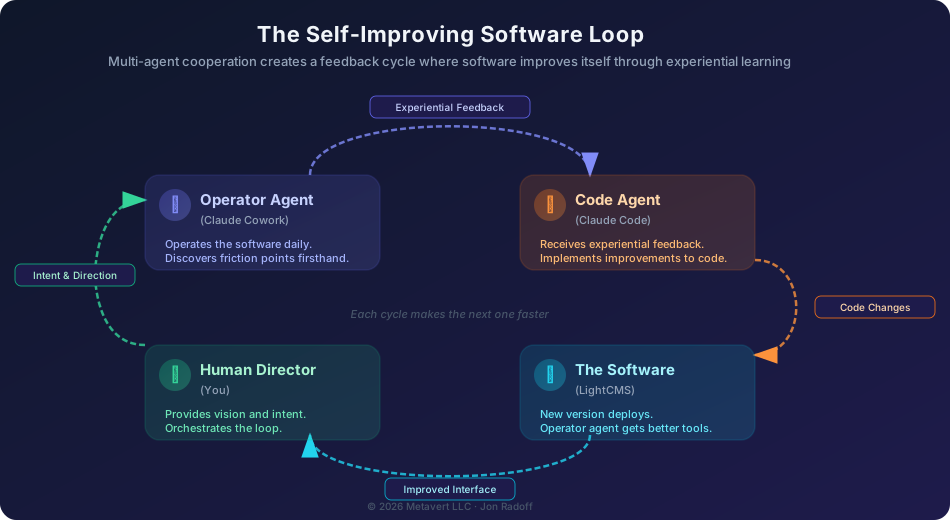
Self-improving software describes systems that participate in their own improvement through feedback loops between specialized AI agents. Rather than relying solely on human developers to identify bugs and implement fixes, these systems use operator agents — agents that use the software in production — to generate experiential feedback that code agents then translate into improvements. The result is a loop where software gets better by being used.
The pattern draws on two deep traditions. In biology, autopoiesis — coined by Maturana and Varela in the 1970s — describes systems that produce and maintain themselves, like cells manufacturing the enzymes that build the membranes that contain the enzymes. In mathematics and philosophy, Douglas Hofstadter's strange loops describe self-referential hierarchies where traversing the levels brings you back to the start, transformed. Kenneth Reitz connected these ideas to software directly: "I keep finding the same pattern everywhere: systems that only exist because they reference themselves. Not just reference — they create themselves through the act of self-reference." Self-improving software is where these concepts meet running code.
What makes the pattern work is the complementarity of agent perspectives. An operator agent accumulates experiential knowledge — it knows what's painful because it feels the friction. A code agent has architectural knowledge — it understands the system's structure and can reason about what's feasible. Neither perspective alone is sufficient. In practice, operator agents have identified critical bugs — like redundant API calls that tripled session costs — that were invisible to the code agent that built the system, because the bug only manifested during real operation. This is convergent multi-agent improvement: two epistemologies producing a better outcome than either achieves alone.
The reason this pattern scales is composability. The operator agent aggregates experiential knowledge, the Model Context Protocol transmits it as structured feedback, and the code agent iterates on the codebase. Each element is modular and recombinable — swap the operator for one that tests accessibility, swap the software for an API gateway, and the loop still works. As verification becomes more sophisticated, the human role shifts from mechanic to orchestrator, and eventually to strategic director.
Self-improving software represents a frontier of agentic engineering — not just humans building software faster with AI, but AI agents improving the tools they depend on through experiential feedback loops. The gap between using software and improving software is collapsing, because agents can occupy both sides simultaneously. This is what the Creator Era of software development looks like in practice.