Jevons' Paradox
Jevons' Paradox is the observation that when technological progress increases the efficiency with which a resource is used, total consumption of that resource tends to rise rather than fall. First described by William Stanley Jevons in his 1865 book The Coal Question, the paradox noted that James Watt's improvements to the steam engine — which dramatically reduced the coal required per unit of work — ultimately led to a massive increase in total coal consumption, because efficient engines made steam power economical for a far wider range of applications.
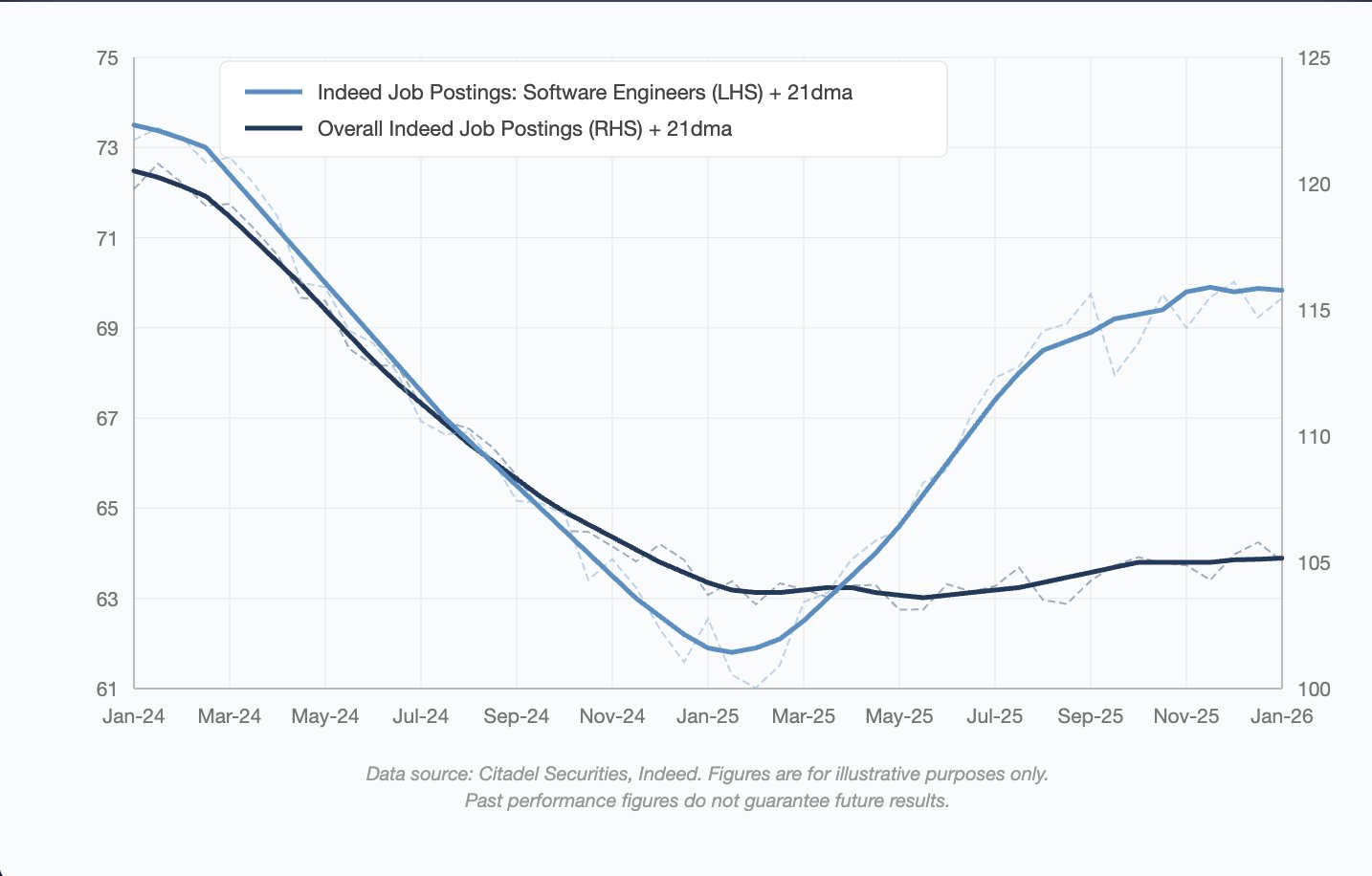
One hundred and sixty years later, the same paradox is playing out in artificial intelligence — and it may be the single most important economic dynamic of the 2020s. The cost of AI inference has dropped roughly 92% since early 2023. Rather than shrinking the market for intelligence, that collapse has detonated an explosion of demand. Software engineer job postings, after tracking closely with overall job postings during the initial AI efficiency wave, dipped below the baseline in early 2025 as companies absorbed productivity gains — then sharply accelerated, ending the year growing significantly faster than overall postings. The pattern is Jevons in miniature: a brief contraction followed by demand expansion that overwhelms the original efficiency gain.
The Mechanism: Why Efficiency Expands Demand
The core mechanism is straightforward: efficiency lowers the effective cost of using a resource, which stimulates demand. When that demand increase — the rebound effect — more than offsets the efficiency gain, total consumption grows. Economists distinguish between a direct rebound (people use more of the now-cheaper resource) and an indirect rebound (savings are redirected to other activities that also consume resources). When the combined rebound exceeds 100%, we have full Jevons' Paradox.
This is the demand-side complement to Wright's Law, which describes how production costs fall predictably as cumulative output doubles. Wright's Law explains why costs decline; Jevons' Paradox explains what happens next. Together they form a flywheel: increased production drives costs down, lower costs drive more demand, and more demand drives further production. The dynamic is visible throughout technology history — semiconductor costs followed Wright's Law for decades, and Jevons' Paradox ensured that cheaper transistors didn't reduce total spending on chips but instead created entirely new markets (PCs, mobile phones, IoT, AI accelerators) consuming orders of magnitude more silicon than the mainframe era ever did. This flywheel connects directly to Flywheel Economics and Deflationary Technology.
The AI Intelligence Market: Super-Elastic Demand
In artificial intelligence, the Jevons effect operates with unusual force because demand for compute turns out to be super-elastic. A January 2026 paper by Zhang and Zhang (The Economics of Digital Intelligence Capital) formalizes this as a Structural Jevons Paradox: as the unit price of intelligence falls, downstream firms don't simply run the same workloads more cheaply — they endogenously redesign their agent architectures to consume dramatically more compute. Falling API prices induce developers to adopt deeper reasoning loops, larger context windows, tool-augmented multi-agent workflows, and chain-of-thought pipelines that multiply token consumption per task. Every cost reduction at the infrastructure layer translates into expanded consumption at the application layer.
Three interlocking dynamics accelerate this. First, a Red Queen Effect: because the economic value of a foundation model is relative — defined by its advantage over competitors rather than absolute capability — firms must continuously invest just to maintain position, and innovation by one firm endogenously depreciates rivals' existing capital. Second, the Structural Jevons Paradox itself: super-elastic demand ensures efficiency gains raise total industry revenue, not reduce it. Third, a Data Flywheel: superior models attract more users, generating proprietary feedback data that further improves the model, creating winner-take-all dynamics. The net effect is an industry where falling per-unit costs consistently produce rising aggregate investment and consumption.
From Macro Data to Ground Truth
This is not merely theoretical. Citadel Securities' early 2026 report The 2026 Global Intelligence Crisis assembled the macro evidence: U.S. unemployment at 4.28%, software engineering job postings up 11% year-over-year, and AI capital expenditure running at roughly $650 billion (~2% of GDP). As their macro strategist Frank Flight argued, the displacement narrative fundamentally misunderstands the demand response — "rising productivity lowered costs and expanded the consumption frontier." The data in the chart above, drawn from Indeed job postings, tells the story visually: the brief period where software engineer demand dipped below the overall trend was not a permanent displacement but a reallocation pause before demand rebounded with force.
Citadel's analysis also identified a secondary paradox: the massive capital expenditure required to build AI infrastructure — data centers, GPU clusters, energy systems — may itself be inflationary, creating what they termed a new "inflationary floor" across the global economy. The efficiency gains from AI are real, but the infrastructure buildout to deliver them generates its own demand wave, reinforcing the Jevons dynamic at the macro level.
Software's Creator Era: Jevons Applied to Cognitive Labor
Perhaps the most consequential manifestation is in software creation itself. Software development is undergoing a transition from the Engineering Era — where building software required trained engineers wielding complex toolchains — to a Creator Era where language models function as "natural language compilers," translating intent directly into implementation (Software's Creator Era Has Arrived). This is Jevons' Paradox applied to human cognitive labor: making software creation dramatically more efficient doesn't shrink the amount of software being built — it expands it explosively.
The mechanism mirrors Jevons' original coal observation with remarkable precision. When building a web application required a team of engineers and months of work, only ideas that cleared a high cost-benefit threshold got built. When the same application can be prototyped by a single person in hours using AI coding tools, the threshold drops dramatically — and millions of ideas that were previously "not worth building" suddenly become viable. The addressable market for software expands, and total volume increases even as per-unit cost collapses.
This expansion cascades through every layer of the stack. More software means more demand for infrastructure that solves genuinely hard problems — scaling, distributed databases, orchestration. More creators mean more demand for AI inference. More applications mean more demand for developer tools, hosting, payments, and distribution. Every creator needs a canvas and a studio; the infrastructure providers benefit from the same expansion that Jevons predicted. The creator economy doesn't shrink the technology industry — it's a Jevons-scale expansion of it.
The pattern repeats throughout history. Spreadsheets didn't eliminate accountants; they made financial analysis so accessible that demand for it exploded. ATMs didn't reduce the number of bank branches — for decades, they actually increased them. Desktop publishing didn't reduce the amount of professional design work; it created an entire industry of digital content. The printing press didn't reduce writing; it created publishing. In each case, efficiency didn't shrink the market — it expanded it beyond what anyone had imagined.
For the agentic economy, Jevons' Paradox — reinforced by Wright's Law cost curves, the architectural super-elasticity that Zhang and Zhang formalize, the macro evidence that Citadel assembles, and the creator-era expansion of who can build software — points to an extraordinary, structural expansion of the entire software and intelligence industry. The question is not whether AI will displace demand. It's how fast the new demand will outrun the displacement.
Further Reading
- Software's Creator Era Has Arrived — Jon Radoff (the Jevons-scale expansion of software creation)
- The Economics of Digital Intelligence Capital: Endogenous Depreciation and the Structural Jevons Paradox — Zhang & Zhang (2026), formalizing super-elastic AI demand
- The 2026 Global Intelligence Crisis — Citadel Securities (Frank Flight), the macro case against AI displacement
- Wright's Law: Cloud, Blockchain, and the Metaverse — Jon Radoff
- Deflationary Technology and the Future of the Metaverse — Jon Radoff